


The Most Important Part of a CEO Search Happens Before the Search Begins
James Abruzzo – President, Abruzzo Associates
Peter Hansen – Principal, Arts, Culture, and Media Philanthropic Advisors
Even in the smoothest, best-planned succession, there are several steps a board should take to maximize the likelihood of a successful search. For our purposes, a successful search is one that results in the right leader at the right moment in the organization’s history—a leader who, two or more years later, has strengthened the organization’s impact and positioned it for future success.
But how does a board determine who the right person is?
A board may rely on a search firm to identify “top candidates,” but a top candidate for one organization may be the wrong candidate for another. This is particularly true when an organization is entering a new phase in its evolution: a major capital project has been completed; new competitors have emerged; economic conditions have changed dramatically; or a different leadership style is needed to navigate the challenges ahead.
Less obvious, but equally important, is the situation in which an organization has enjoyed a successful twenty-year run under a highly effective CEO. In such cases, the board may not fully appreciate how the environment has changed during that period or what new challenges lie ahead. Success can sometimes obscure the need for adaptation.
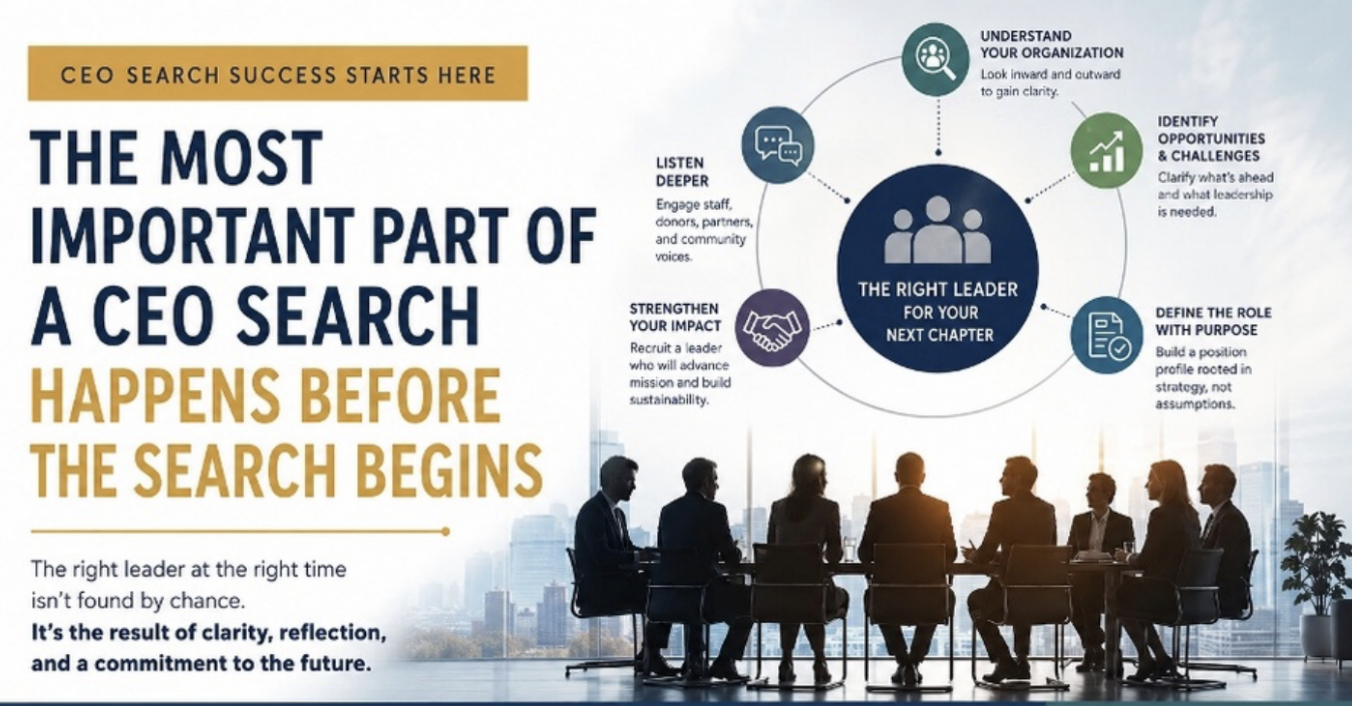
For this reason, the search process should begin not with candidates, but with reflection. Before it can define the qualities sought in a new leader, the board must first gain a deeper understanding of the organization itself, its relationship to its community, and the challenges and opportunities that lie ahead.
The board must therefore undertake a deliberate journey of understanding. This process should extend well beyond the boardroom.
It may include confidential interviews with staff, conversations with volunteers and vendors, meetings with community leaders and partner organizations, and discussions with major donors, subscribers, members, and audience participants. In some cases, a large-scale survey of stakeholders can provide valuable insights into how the organization is perceived, where it excels, and where it falls short.
The goal is not simply to gather opinions, but to develop a clearer picture of the organization’s strengths, weaknesses, opportunities, and challenges. Equally important is identifying those constituencies the organization has not historically served or engaged. The future leader may be called upon not only to strengthen existing relationships, but also to build new ones.
If the executive search firm lacks the capacity or expertise to conduct this level of organizational assessment, the board may need to engage a market research firm or other consultant to assist. Ideally, however, the search firm will possess both capabilities: the ability to help the board understand the organization it has today and the ability to identify the leader it will need tomorrow.
Only after this work is completed should the board begin to define the position itself. What experiences, competencies, leadership style, and personal qualities are most needed? What challenges will the new executive face during the first three to five years? What opportunities will he or she be expected to seize?
What constituencies must be cultivated? What aspects of the organization’s culture should be preserved, and which may need to evolve?
The answers to these questions become the foundation of the search. They inform the position specification, guide candidate evaluation, and provide a framework for assessing whether a candidate’s skills and experiences truly match the organization’s future needs.
In the end, the most successful searches are not simply exercises in recruitment. They are exercises in organizational self-discovery. The board’s responsibility is not merely to find the most accomplished candidate available. Its responsibility is to identify the leader best equipped to guide the organization through its next chapter and to create the conditions that will allow that leader to succeed.
A mission-driven organization’s ability to fulfill its purpose depends on its financial capacity. As part of its deliberate journey of understanding, the board must take an honest look at its fundraising ecosystem and ensure that the next CEO has the leadership skills and expectations necessary to grow contributed revenue and advance mission. We recommend that the board take the following steps to define the fundraising competencies and leadership capabilities required in its next CEO:
CONDUCT AN OBJECTIVE SELF-ASSESSMENT OF THE FUNDRAISING ECOSYSTEM
The board should lead a candid assessment of fundraising performance, resources, gaps, and external factors to determine the capabilities needed in the next CEO. This assessment should be data-informed, future-focused, and inclusive of board members, staff, donors, and other key stakeholders.
DEFINE FUNDRAISING AS A CORE CEO COMPETENCY
In establishing the CEO position description, the board should define fundraising as a core competency and establish clear expectations for the incumbent to serve as co-chief development officer. Too frequently, organizations recruit chief executives with strong programmatic or administrative skills but little expectation that they will actively participate in fundraising. This creates a significant roadblock to sustainability. The CEO must set the organizational vision, build donor relationships, inspire a culture of philanthropy, and help drive contributed revenue. Fundraising is not just the responsibility of the development department—it is a leadership responsibility.
A COMMITMENT TO SUSTAINABLE IMPACT
When boards do their homework and set clear expectations, they empower the next CEO to lead with vision, credibility, and results. A CEO who embraces fundraising as a core component of the role becomes a powerful catalyst for mission advancement and long-term sustainability.
The future of your mission depends on the leadership you recruit today.